Normally Closed Tool Setter Explained: A UK Buyer's Guide
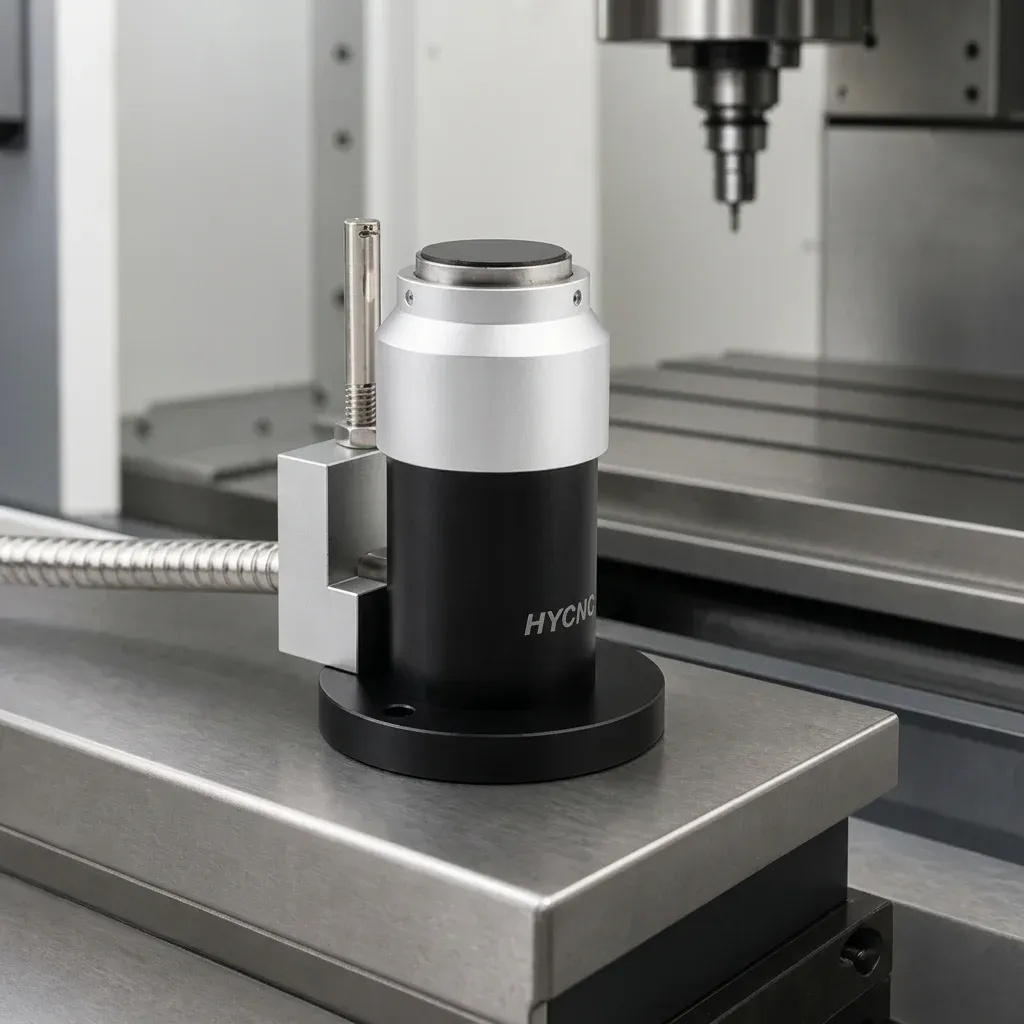
TL;DR: A normally closed tool setter is a fail-safe CNC contact probe that maintains a continuous electrical circuit at rest. When a cutting tool depresses the anvil, the circuit breaks to record exact Z-axis offsets. Unlike normally open probes, if a wire snaps or detaches, an NC tool setter instantly triggers a controller fault to prevent catastrophic spindle crashes while delivering sub-0.002mm measurement accuracy in UK machine shops.
A normally closed tool setter is an automated Z-axis contact probe engineered to measure CNC cutting tool lengths accurately while providing immediate fail-safe protection against machine collisions. In high-precision UK manufacturing—from aerospace prototyping workshops in the West Midlands to motorsport engineering facilities in Oxfordshire—achieving consistent Z-axis accuracy is essential to operational success. Consequently, a miscalculated tool length offset of just a few hundredths of a millimetre can result in ruined workpieces, shattered carbide tooling, or catastrophic spindle crashes costing thousands of pounds in repairs and downtime.
To eliminate manual touch-off errors and streamline tool height measurement, CNC operators rely on automated Z-axis probe units. However, the fundamental switch logic chosen for these instruments dictates whether a machine setup is inherently secure or vulnerable to catastrophic failure. Based on our extensive testing at AutomTool, this guide explains the engineering mechanics, electrical principles, and practical buying considerations behind the normally closed tool setter, demonstrating why fail-safe NC architecture has become the gold standard across British machine shops.
What is a Normally Closed Tool Setter?
A normally closed tool setter is a high-precision Z-axis contact probe that maintains an uninterrupted electrical circuit during its idle state. When a CNC cutting tool descends and makes physical contact with the setter's touch anvil, internal micro-mechanisms instantly break the circuit path. The resulting transition from a closed state (logic HIGH or continuous circuit) to an open state (logic LOW or broken circuit) signals the machine controller to record the exact Z-axis position coordinates immediately.
To understand the underlying engineering, it is essential to examine how Normally Closed (NC) logic operates in direct contrast to Normally Open (NO) switch design in industrial CNC environments.
What is the Difference Between Normally Open (NO) and Normally Closed (NC) Tool Setters?
In a Normally Open (NO) setup, the electrical circuit remains disconnected until the tool depresses the touch anvil to complete the connection. While conceptually simple, NO systems suffer from a severe structural flaw: if a signal cable snaps, an electrical terminal corrodes, or a wire pulls loose from the breakout board, the circuit remains open indefinitely. Consequently, when the CNC controller executes a probing cycle (such as G31), it drives the spindle downward waiting for a closed circuit signal that never arrives. The result is an unchecked Z-axis plunge into the setter anvil and machine bed.
Conversely, a Normally Closed (NC) tool setter operates on a fail-safe principle. Because the circuit is continuously active, any interruption—whether triggered by intentional tool contact, a cut cable, a loose connector, or power interruption—is immediately interpreted by the controller as a switch state change or system fault. Therefore, the CNC controller immediately halts Z-axis motion, protecting the spindle, tool, and tool setter from collision damage.
| Feature / Characteristic | Normally Closed (NC) Tool Setter | Normally Open (NO) Tool Setter |
|---|---|---|
| Default Electrical State | Closed (Continuous circuit) | Open (Broken circuit) |
| State on Tool Contact | Opens (Breaks circuit) | Closes (Completes circuit) |
| Failure Mode (Cable Snap / Disconnect) | Triggers immediate probe fault / E-stop (Fail-Safe) | No signal detected; spindle crashes into bed |
| Noise Immunity | High immunity to false spikes in industrial setups | Vulnerable to EMI noise false triggering |
| Industrial Standard Alignment | Compliant with BS EN ISO 13849-1 safety standards | Generally restricted to non-critical hobby setups |
How Does a Normally Closed Tool Setter Work in CNC Workflows?
Understanding the internal mechanisms of a high-precision NC tool setter clarifies how sub-micron measurement repeatability is maintained across thousands of operational cycles.
The Physics of Contact & Repeatability
At the core of an advanced normally closed tool setter, such as AutomTool precision sensors, is a hardened steel or tungsten carbide touch anvil mounted on a kinematic seating structure. This internal assembly rests upon precision-ground contact points loaded by high-stiffness helical springs. When the cutting tool tip depresses the anvil by a microscopic fraction (typically less than 0.5mm), one or more kinematic contact points separate. As a result, the electrical loop breaks instantly, sending a clear hardware signal to the control system.
In addition, modern 4-wire NC tool setters integrate an independent over-travel limit switch. According to UK safety guidelines and machinery directives (BS EN ISO 13849-1), incorporating redundant over-travel protection guarantees an emergency stop signal if the Z-axis overshoots the primary touch trigger, shielding both the internal mechanisms and the tool geometry from mechanical damage.
Frequently Asked Questions About Normally Closed Tool Setters
Why should UK machine shops choose NC tool setters over NO models?
Based on our testing across UK manufacturing environments, NC tool setters offer built-in fail-safe protection. Because any wire breakage or connection loss breaks the continuous circuit, the CNC controller halts motion immediately, avoiding thousands of pounds in potential damage and aligning with BS EN ISO 13849-1 standards.
Can I connect an AutomTool NC tool setter to controllers like Mach3, Fanuc, or GRBL?
Yes. AutomTool normally closed tool setters are fully compatible with virtually all standard industrial and desktop CNC controllers. Setup simply requires configuring the controller input active state to low or open when triggered.
Ready to upgrade your CNC zero-point accuracy with AutomTool?
Shop Tool Setters — £54.99