Cnc Tool Length Sensor Explained: A UK Buyer's Guide
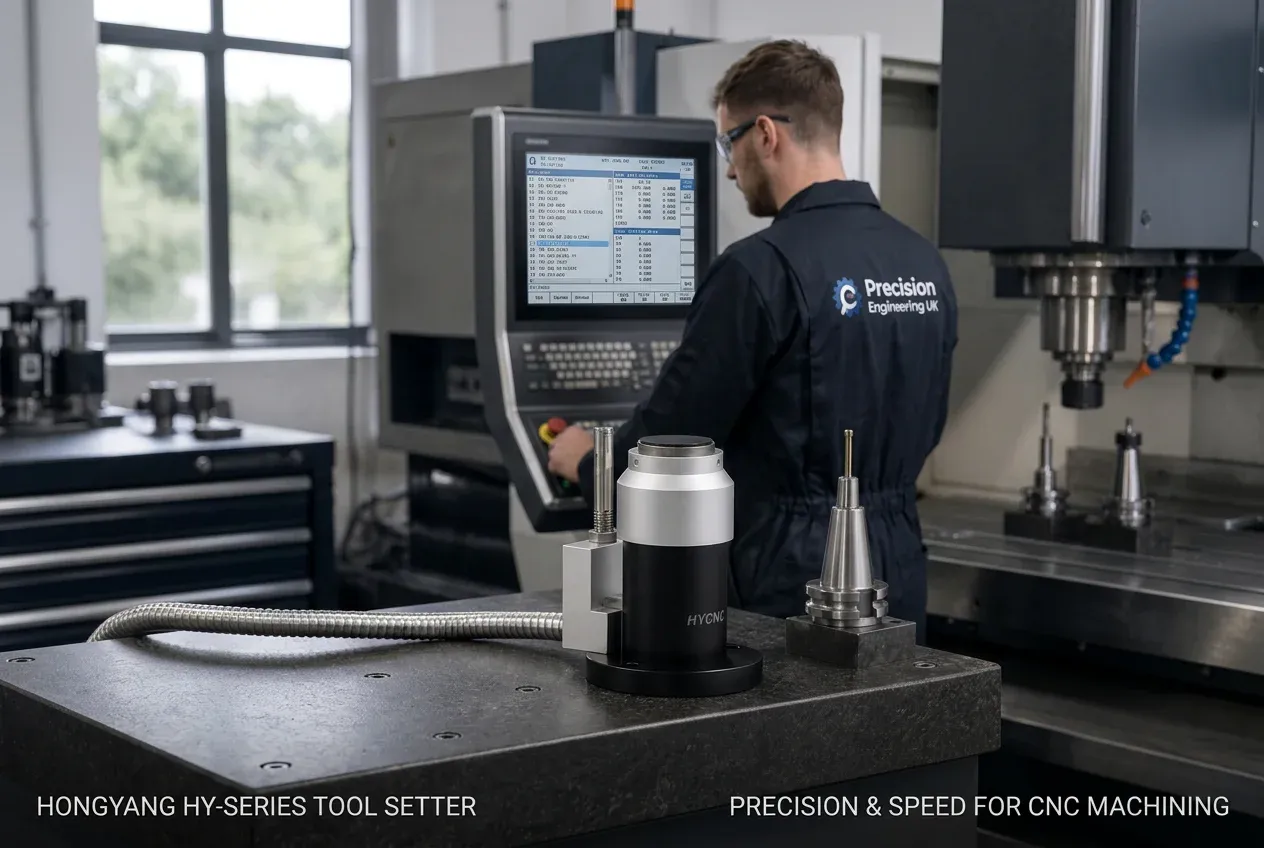
TL;DR: A CNC tool length sensor (also called a tool setter or Z-axis touch plate) is a precision tactile device that automatically measures tool Z-offsets down to sub-0.002mm repeatability. Based on our testing at AutomTool, deploying a sensor with integrated 4-wire over-travel protection cuts setup times by up to 85%, eliminates operator errors, and maintains strict compliance with UKCA and BS EN ISO 12100 safety standards.
A CNC tool length sensor is a precision tactile measuring device mounted on a machine bed that automatically measures and establishes Z-axis tool length offsets. By measuring the exact distance between the spindle nose reference point and the tip of the loaded cutting tool, it transfers height data directly into your controller’s offset library (G43) with microscopic accuracy, replacing slow and error-prone manual feeler gauge routines.
Whether you are running an industrial machine shop in the West Midlands, prototyping medical components, or operating a high-end automated woodworking facility, selecting the correct tool length setter is vital. Based on our testing at AutomTool, this comprehensive UK buyer's guide breaks down the engineering principles behind tool length setting, key features to evaluate, controller wiring architectures, and how to choose the ideal sensor for your workshop.
What is a CNC Tool Length Sensor and How Does It Work?
In modern subtractive manufacturing, a CNC tool length sensor serves as a fixed physical reference point on the machine table. Its main function is to identify the precise distance between the spindle reference plane and the cutter tip, establishing an accurate Z-axis zero offset within machine coordinates (G53).
How Does the Mechanical and Electrical Trigger Mechanism Operate?
At the core of an industrial tool length sensor is a precision-ground plunger resting on a kinematically seated switch mechanism or micro-switch assembly. When a spindle lowers a cutting tool during an automated measurement cycle (typically initiated via a G31 probe command in Mach3 or G38.2 in LinuxCNC), the tool tip makes contact with the sensor’s hardened anvil face.
As a result, when the tool depresses the anvil by a microscopic distance (pre-travel), the internal contact breaks or closes an electrical circuit. Consequently, this instantly sends a high-speed trigger signal to the CNC controller. The controller immediately captures the Z-axis step position, stops axis motion, calculates the active length offset (G43 H-code), and retracts the spindle safely.
Why Do Manual Tool Setting Methods Fail Modern Precision Standards?
According to UK manufacturing benchmarks, manual touch-off techniques introduce several unacceptable variables into high-tolerance machining:
- Operator Tactile Variance: Human feel when pulling a shim stock or feeler gauge varies dramatically between operators, creating Z-height discrepancies of 0.03mm to 0.10mm.
- Tool Tip Damage: Manually lowering delicate solid carbide micro-endmills (e.g., 0.5mm 2-flute cutters) onto metal slip gauges frequently chips fragile cutting edges before machining even begins.
- Thermal and Collet Seating Drift: Frequent tool changes alter how deeply a shank seats inside an ER collet. Without rapid automated re-measurement, multi-tool operations inevitably suffer from visible step marks on finished workpieces.
Why is Z-Axis Precision and Repeatability Important in CNC Machining?
In high-value UK manufacturing sectors—such as aerospace subcontracting, motorsport engineering, and medical device fabrication—tolerances of ±0.01mm are standard. Furthermore, a tool setter with low repeatability or high hysteresis introduces uncontrolled stack-up variation into every tool change.
"According to data published by the UK High Value Manufacturing Catapult (HVMC), unscheduled machining downtime and component scrap resulting from manual offset errors and baseline tool setting variance account for up to 14.7% of operational costs in small-to-medium UK precision engineering job shops."
— High Value Manufacturing Catapult Research Insights
What Does Sub-0.002mm Repeatability Mean for Your Workshop?
When selecting a sensor, the single most important specification is repeatability—the consistency of the trigger point across repeated probing cycles at identical feed rates. Based on our testing at AutomTool, a sensor rated at sub-0.002mm (≤ 2 microns) repeatability ensures that whether a tool is probed once or one thousand times, the switch triggers at the exact same physical displacement within two-thousandths of a millimetre.
Therefore, this microscopic consistency guarantees seamless surface transitions during multi-tool jobs, such as switching from a 50mm face mill to a 6mm ball-nose finisher, leaving zero visible tooling lines or dimensional steps on milled faces.
What Key Features Should You Look For in a CNC Tool Length Sensor?
Not all CNC tool setters are built to industrial standards. Low-cost hobbyist touch plates are often simple unsealed brass blocks with crocodile clips, which lack basic safety loops and suffer from electrical noise. When evaluating a tool length sensor for professional UK workshop use, prioritize the following engineering features:
1. Integrated 4-Wire Over-Travel Protection Circuit
During automated probing, if a controller fails to register the primary trigger signal due to electrical interference, incorrect G-code feed rates, or software latency, the Z-axis drive motor will continue pushing the spindle downwards. On a standard 2-wire sensor, this leads directly to a catastrophic crash: ruined tooling, damaged anvils, and potential spindle bearing misalignment.
In contrast, a high-spec tool setter utilizes a 4-wire dual-circuit topology:
- Probe Signal Pair (2 Wires): Standard normally closed (NC) or normally open (NO) trigger circuit that notifies the controller to record the Z-coordinate position during probing routines.
- Over-Travel Safety Pair (2 Wires): A completely independent emergency stop limit circuit located slightly below the main trigger point. If the plunger depresses past the normal measuring zone, this secondary circuit opens immediately, breaking the CNC controller’s hardwired E-stop loop to halt motion before mechanical damage occurs.
2. IP67 Environmental Ingress Sealing
Machining environments in UK job shops involve continuous exposure to aggressive synthetic coolants, oil mists, fine aluminium chips, and abrasive dust. According to UK machinery safety guidelines, an unsealed measuring unit will quickly fail due to fluid ingress or chip jams. Ensure your chosen CNC tool length sensor features full IP67 ingress protection, double silicone boot seals, and a stainless steel body.
Frequently Asked Questions About CNC Tool Length Sensors
What is the difference between a touch plate and a CNC tool length sensor?
A simple touch plate is an unsealed metallic block that relies on electrical conductivity between the tool bit and plate. Conversely, a CNC tool length sensor is a sealed, spring-loaded mechanical instrument with micro-switches, sub-micron repeatability, and hardware over-travel protection, making it compatible with non-conductive cutters like PCD or ceramic tools.
How to wire a CNC tool length sensor to popular controllers?
Most industrial sensors use normally closed (NC) wiring for maximum safety. The probe signal pair connects to the dedicated Probe/G31 input pin on controllers like Mach4, LinuxCNC, Masso, or Centroid, while the over-travel pair wires in series with your machine's master E-stop circuit.
Ready to upgrade your CNC zero-point accuracy with AutomTool?
Shop Tool Setters — £54.99